Let’s Get Metaphysical

There are some great birds on this week’s Arizona RBA, everything from Sinaloa Wren to Yellow-throated Vireo, from Ruby-throated Hummingbird to Plain-capped Starthroat; but what has most caught the eye of discerning locals is the report of a very young juvenile Short-tailed Hawk above Madera Canyon. This is still a very rare species in the southwestern US, and the thought that this bird might have been hatched in the Santa Ritas is an exciting one, potentially extending the breeding range of the species quite a ways north and west from its strongholds (a relative term in connection with a bird this scarce!) in the Chiricahuas and Huachucas.

There can be no doubt about the identification, of course (the observer is one of the very best), but it is nice that he was able to photograph the hawk, too. And here’s where things get interesting, to me at least. The RBA, well and conscientiously crafted this week by a couple of excellent and thoughtful birders, pronounces this photograph the first “physical documentation” of the species in the Santa Ritas.

Wait a minute. “Physical”? Did Dave shoot the poor thing?

Of course he didn’t. What the compilers meant to do here was to contrast photographic documentation and written documentation. I won’t belabor the fact (as I usually do) that photographs should be viewed as only supporting material for written documentation, but I will point out that there is nothing “physical” about a photograph–or a sound recording–or at least, that whatever “physicality” those forms of representation participate in is shared by written documentations.

What’s “physical” and what’s “immaterial” in this photo?

It’s my belief, my assertion, my unyielding insistence that only the paper-towel-shrouded corpse (a House Sparrow that gave its life, reluctantly, for science) is ontologically “superior” to the written documentation, and that the photo on the cd and the image on the slide and the recording on the cassette tape (remember cassette tapes?) are in fact less “physical” than any of the other objects and artifacts they share the screen with.

Anyone who disagrees with me is, hm, wrong.

Obviously, I hope that my readers (both of them) are skilled at detecting irony and (slight) overstatement; but I’m equally hopeful that someone “out there” will propose a better, more precise formulation than “physical documentation” for the sorts of evidence represented by photographs and sound recordings. Be prepared: I’ve already thought of the obvious alternatives, and am ready to reject them all with vehemence.

A big smile for the rest of the weekend!

Share

When Is a Robin not a Robin?

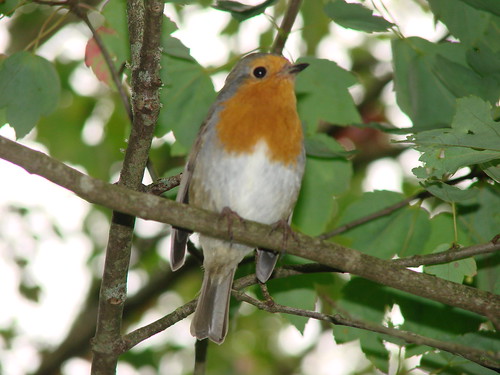
Does this look like a robin to you?

Depends on where you live, I guess: “robin,” like “sparrow” and “chat” and “bunting” and so many other English bird names, means different things to different people all around the English-speaking world. But it isn’t the notorious ambiguity of such words that’s bugging me; it’s whether in a very specific case that polysemy is natural or imposed, “naive” in the Schillerian sense or contrived.

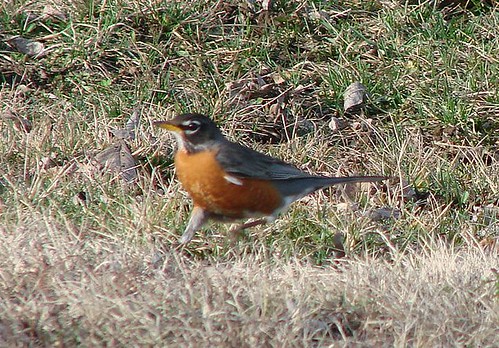
Does this look like a robin to you?

It doesn’t to me, and I’ve always through there was something more than a little fishy (fishwormy, perhaps?) about the story we learned as kids: “Robins were named by homesick European settlers for their beloved and familiar little Robin Red-breast, which has a color pattern brighter but somewhat similar to our robin, though the two species are not closely related” (this from a website for schoolchildren called “Journey North”).

Sounds like an extra-wide load of sentimental claptrap to me. It must have taken an almost debilitating case of nostalgia to make anyone think of the demure little European Robin when they first saw this great boisterous ground-loving thrush. The decidedly chat-like Eastern Bluebird, yes, similar to Erithacus in posture, in plumage, and even, if your ears haven’t been home for a good long time, in vocal tone.

But American Robin? No way. There was no need for the first European Americans to reach for so far-fetched a comparison when they had plenty of experience of obviously more similar thrushes at home. American Robin calls like a European Blackbird (see Audubon), sings like a Song Thrush (see Swainson), acts like a Fieldfare, and for all I know, probably tastes like a Mistle Thrush. So what did they really call this spectacular new bird?

A definitive answer–or more likely answers, given that birds as conspicuous as this almost always have a number of names–is to be had only after a thorough review of all the earliest lists of North American birds and other natural historical sources of the sixteenth and seventeenth centuries; if you’ve got the time, I’ve got the ear. But even just sitting here at my desk, with the OED and the AOU Check-list at hand, I can start it off. And I think I can see where it’s going.

The earliest attestation of “robin” in reference to the bird we know as Turdus migratorius is from 1798–and tellingly enough from an English, not an American, publication. Not for another decade would an American source adopt the name; Alexander Wilson cited the “robin” as an early singer. But Bartram, a generation before Wilson, called the bird “field fare,” and so in the 1730s did Catesby, whose well-known painting of a robin lying dead on its back atop a stump is labeled “The Fieldfare of Carolina.” This painting of a “fieldfare” was the source for Linnaeus when in 1766 he described and named Turdus migratorius.

Without digging a bit deeper, I won’t suggest that no one before 1798 ever called our red-breasted thrush (Swainson’s name for it) a “robin,” but even the few historical milestones set down in the OED and the Check-list suggest strongly that at least until the turn of the 19th century “fieldfare” was a common and familiar name for this common and familiar bird. It’s also a much more sensible, much more logical name than “robin,” and I suspect that a little more research will show that the latter was imposed on the bird much later than the former. “Robin” for Turdus migratorius will turn out to be a contrived name, a “book name,” that displaced the real name, the folk name, “fieldfare,” some time in the late 18th century.

The real question: why, and by whom? Stay tuned, and maybe someday I’ll work it out. Or maybe you already know the answer.

Share