David Sibley has a particularly fine illustration of a nighthawk wing here, along with other examples of molt timing’s being useful to identification.


The Experience of Birding
David Sibley has a particularly fine illustration of a nighthawk wing here, along with other examples of molt timing’s being useful to identification.
These late summer sunsets are the more beautiful for the Lesser Nighthawks tracing their extravagant loops through the pink sky, skimming the desert floor, then swooping high above the houses and saguaros.

The image is a poor one even by my generous standards (well, let’s call it “artistic”), but I like it very much because if you squint just right, you can see that the odd shape of the wing patch is in fact a molt artifact–the bird, like all the others swarming our front yard this evening, is missing a primary or two, leaving the wing patch to “float” on the end of the wing. This time of year, no Common Nighthawk should be molting primaries, making this yet another somewhat difficult species pair that can be separated, provisionally at least, by the presence or absence of wing molt on the breeding grounds. Cool.
Like anyone else with sense, I love jacamars, and so I lingered over last November’s poor images of Paradise Jacamars when I was moving them to flickr tonight.
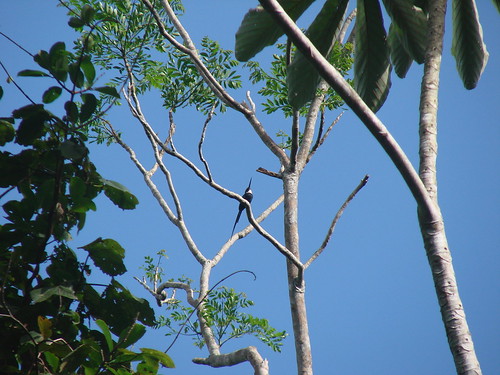
Quite a bird, as sharp at one end as at the other!
One of my photos, though, offered up a surprise–and a mystery.
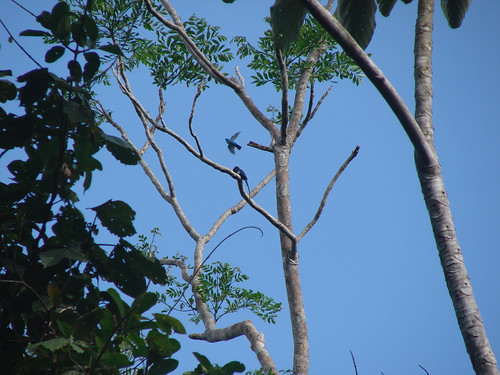
In flagrant violation of Rule 2 for Successful Birding, I was looking at the stupid viewfinder when something flashed across the background. What is it?
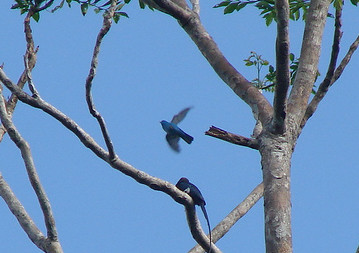
Is it really blue? I’m at a loss, never having seen a Cotinga cotinga fly.