
Archive for June, 2007

Mike O’Connor owns the Bird Watcher’s General Store at the Orleans rotary on Cape Cod, an institution celebrating, if I figure it right, its 25th jubilee next year (the store, I mean, not the rotary or Cape Cod). In those two and a half decades, he has answered thousands of questions; most, he writes, were easy–”the hard part is keeping a straight face.”

Fortunately, O’Connor doesn’t even try to keep a straight face in this little book, a compilation of questions and answers from his long-running newspaper column “Ask the Bird Folks.” Most of the queries are fairly mundane (“Is it okay to feed birds peanut butter?”), and it seems unlikely to me that most beyond-the-backyard birders will learn much of substance from the answers; but that doesn’t make the reading any less entertaining. I don’t often laugh out loud when I read a bird book, but I snickered more than twice at this one.

The greatest challenge in assembling an anthology is organizing the material, which here, by the nature of a newspaper column, tends to be thematically untidy. Backyard bird-feeding questions are covered in four sections, while another is devoted more generally to birds “you should know about,” from ostriches to the Great Auk. Equipment questions, touching on feeders, binoculars, and field guides, fill another chapter, and the book’s least interesting 20 pages are given over to identification matters. A final, miscellaneous section provides “information nobody should be without,” in reply to questions about Ludlow Griscom, White Storks, and bird sleep, among other topics.

O’Connor’s responses tend to be brief, a page or two at most, and proceed by answering the specific question (“Do we ever get Wood Ducks here?” “Yes.”) and then providing a short, simply written essay on the bird or behavior in question. These discussions are accurate, easily understood, and witty, and beginning birders and feeder-watchers, especially in the northeastern United States, will profit from them. Only very rarely did my editorial eye look askance; in his advice to the first-time field guide purchaser, O’Connor recommends books with “illustrations” over those with photographs (he means paintings, of course), and in a discussion of Picoides identification, he passes on an erroneous but frequent origin for the names “hairy” and “downy” (Catesby was in fact referring to the plumage of the back).

These matters are so trivial that even I blush in pointing them out. This is a book to be recommended to backyard birders and beginners, and to more experienced birders in search of a light-hearted read. Where else can you find such practical and entertaining advice as the suggestion that a small child tied to a long pole is the ideal way to fill feeders hung high off the ground, or the warning that chocolate ice cream fed to the birds may well draw an unwanted flock of in-laws instead? Buy it, read it, and give it to your friends and neighbors.

  • Share/Bookmark
Categories : Book Reviews
Comments (0)
Jun
30

Bulgaria 2007: Larks, Larks

Posted by: Rick Wright | Comments (0)

I like larks, and if I have anything to regret about being born a North American, it’s that we have only one (but a splendid one, of course) species of alaudid to entertain us. It’s different in the Old World, and Bulgaria has its nice little share of fancy larks to enjoy.

Skylarks, of course, were the commonest, their familiar songs everywhere around us when we were in the countryside.

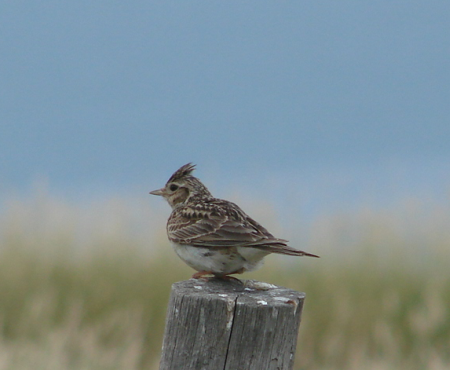
Crested Larks were common in most of the villages, but for some reason I never managed to get a presentable photo; this one will have to do, and you’ll have to believe me that the bird is really very attractive.

We also had the great good fortune to have very good looks at Woodlarks a couple of times. In fact, our best looks were so good that I forgot to take a picture, entirely absorbed in admiring the birds as they fed just a few feet away on the ground. I was reminded again on this trip how bat-like singing birds can look, their wingtips rounded and their tails oddly short.

Those three species are all widespread in Europe, but Calandra and Greater Short-toed Larks are more restricted in their ranges, typical birds of steppe and overgrazed fields in the south and east.

On only one day did we have Greater Short-toed Larks, fine little sandy birds with sooty necksides and a slightly maladroit song flight: fly, then sing a phrase, then fly some more, then another phrase, as if they had trouble doing both at once. One bird I watched for some time had a song phrase somewhat like the ascending jingle of Horned Lark, and I kept looking for that bird until I figured out that it was in fact “just” the short-toe tinkling away over my head.

The same habitat harbors Calandra Lark, a great bruiser of a bird that we saw along the edges of rough fields, too. The size, dark underwing, and exaggerated slow flapping made me think of shorebirds in flight display.

This bird was on its way to feed young. Though the picture is no better than it should be, it does show the dark underwing and the extremely broad trailing edge to the secondaries.

On one of our last days, we went high into the mountains to look for Horned Larks. We missed them, but I can’t say I was disappointed in the lark show that we had had.

  • Share/Bookmark
Comments (0)
Jun
30

Montosa Canyon: Birds and Bugs

Posted by: Rick Wright | Comments (0)

Beauty and accessibility were not enough to make Montosa Canyon famous, but the Black-capped Gnatcatchers that moved in there several years ago pulled it off. Nowadays, this gorgeous shallow canyon on the west flank of the Santa Ritas is perhaps the easiest place in the US to find the species.

When they’re there, that is. A little more than two hours of searching this morning turned up nary a peep or buzz; but Darlene and Michael and I enjoyed our time all the same, not least because it was refreshingly cool for the first hour or so. Well, cool by recent Tucson standards.

A summertime walk in Montosa is always filled with Bell’s Vireos. Families of incessantly begging fledglings were everywhere, the parents singing occasionally in between stuffing caterpillars down the kids’ insatiable throats. Summer Tanagers and Crissal Thrashers, an odd combination, sang from the hillsides, occasionally straying into the territory of a pair of wrathful Cassin’s Kingbirds. And both Ash-throated and Brown-crested Flycatchers were apparently feeding young in nests unseen.

All of this avian abundance is due to one fact: Montosa Canyon is buggy beyond belief in the summer. Not mosquitoes, fortunately, but a vast diversity of wasps, bees, hornets, flies, butterflies, moths, ants, velvet ants: you name it, and if it crawls and creeps, it’s in there.

I’d expected this huge Acanthocephala to be easy to photograph, but they turned out to be surprisingly coy, going behind the branches when I got too close, even flying away when they felt the camera’s eye intruding. They were especially abundant where desert broom had been scraped or broken, sucking down the sap.

  • Share/Bookmark
Categories : Information
Comments (0)
Jun
29

Bulgaria 2007: A Black Sea Clifftop

Posted by: Rick Wright | Comments (0)

The little seaside village of Sinemorets was a relaxing base for a couple of mid-trip days. Red-backed Shrikes and Hawfinches were easily watched in the gardens, and a Little Owl frequented the balconies of one of the newer hotels. But the real attraction was a brushy pasture atop a steep cliff, five minutes’ walk from town.

As everywhere in the Bulgarian countryside, Eurasian Skylarks sang with blithe spirits in the tall grass.
Less common were Tawny Pipits, which Frank and I had a great time watching early one morning before breakfast. This was a species I’d seen only once before, in southern France, and it was great to have leisurely looks at this handsome bird.
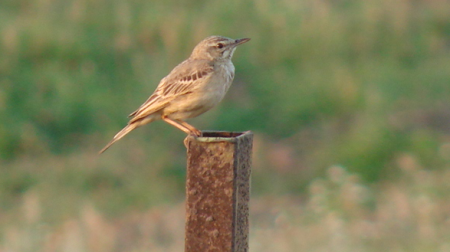
They have a beautiful flight song of ascending “zing” notes, and this species would become a characteristic sight and sound as we moved north along the Black Sea.

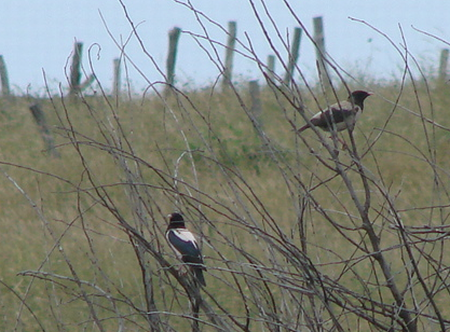
The biggest prize, though, was a gang of four Rosy Starlings, which I stumbled across on a pre-supper walk. These turned out to be the only birds of that species for the entire trip, as wonderfully improbable in their pinkness as I had always expected them to be.

  • Share/Bookmark
Comments (0)
Jun
28

Panama: Rodent Identification

Posted by: Rick Wright | Comments (0)

Thank you to Dale for consulting none other than Fiona Reid to identify our Panamanian rat. It turns out to be a Dusky Rice Rat, Melanomys caliginosus, found in low- to mid-elevation (ca. 1,000m) Caribbean-slope forest.

Thank you, Fiona! (And her new Peterson guide is outstanding, by the way, for which thanks as well.)

  • Share/Bookmark
Comments (0)

 Subscribe in a reader

Nature Blog Network