Archive for Quizzes

Nov
26

Quiz Answer

Posted by: Rick Wright | Comments (1)

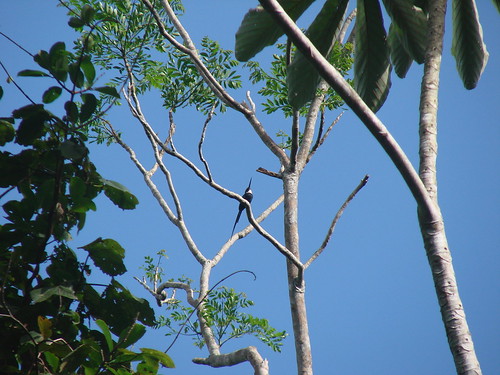
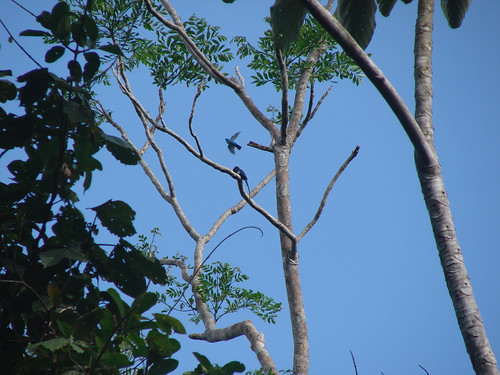
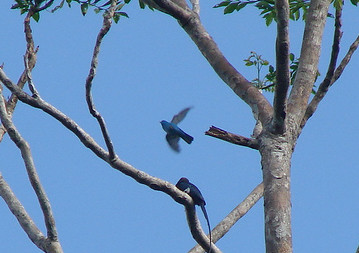
Aha, it does have a head! This Prairie Falcon was intimidating every bird in sight from its perch high above Tucson’s Reid Park. I had been tracking down an audible Acorn Woodpecker–a decent rarity in southeast Arizona’s lowlands–when the big falcon swooped in low, scattering everything with feathers and silencing even the noisy picid.

Identifying the bird wasn’t hard, in flight or in this perched view, but it might have been a little bit more challenging without a look at the head.

Even then, though, I think the rather long, tapered tail and long, sharp wingtip–along withe slender toes–made the determination of genus easy. And there’s no other falcon in southeast Arizona that is this white beneath. If you look closely, you’ll see that the sides of the lower breast are distinctly dark, a sort of “spillover” of this species’ distinctive blackish axillars.

  • Share/Bookmark
Comments (1)
Nov
24

A Quiz Photo

Posted by: Rick Wright | Comments (8)

It’s probably not that hard, but I’m proud enough of this photo to want to make it into a quiz:

The bird was perched high in a eucalyptus in a central Tucson park yesterday noon.

What do you think?

  • Share/Bookmark
Comments (8)
Oct
28

A Quiz: An Answer

Posted by: Rick Wright | Comments (0)

Impressive! I refuse to believe that the quiz was too easy–it’s just that my readers are too smart for me.

Yellow-headed Blackbird. Arizona, October

Yellow-headed Blackbird. Arizona, October

Yellow-headed Blackbirds are abundant and conspicuous winter residents of pastures, fields, and feedlots here in southeast Arizona–so common that a few minutes’ observation will give you plenty of views from angles you might perhaps have preferred to do without.

This first-basic male Yellow-headed Blackbird (note the blackish body plumage and the tiny white square at the base of the primaries) is readying himself to drink, in the process revealing the patch of yellow feathers surrounding the cloaca. This “anal circlet” (Twedt and Crawford’s kind of unfortunate term in BNA) surprises many birders when they see it for the first time–as it did me lo-these-many ago.

Yellow-heads are commonest in the West, of course, but this is a good time of year to be looking for vagrant individuals across the entire continent. There were three in coastal Georgia a couple of weeks ago, for example, and any big flock of Red-winged Blackbirds or Common Grackles is worth a look.

  • Share/Bookmark
Comments (0)
Oct
26

A Quiz

Posted by: Rick Wright | Comments (5)

A common and familiar North American bird showing a field mark many birders don’t know. Whadday think?

  • Share/Bookmark
Categories : Quizzes
Comments (5)
Sep
03

Feather Quiz: Greater Roadrunner

Posted by: Rick Wright | Comments (1)

The first step with an unknown feather is to remind yourself of where you are: this beauty was lying out in the open in hard-core Sonoran desert just west of Tucson. The next step is to figure out where the feather came from–not necessarily from what species, but rather from what part of the unknown bird.

Anything this long and narrow, curved with a strong shaft and obviously stiff vane, has got to be a flight feather. Its attenuated appearance and the fact that one vane is so much narrower than the other tells us that it is a remex, a flight feather of the wing, and almost certainly a primary, one of those long, rigid feathers attached to the bird’s wrist and hand.

We know, too, that it’s from the right wing: the leading edge of the feather is always the narrower vane.

As there’s no tissue adhering to the free bit of the shaft, the feather was either molted naturally or plucked when the bird was freshly dead.

The extreme wear to the feather, with great chunks of missing barbs on the trailing vane, suggests that it is from an adult bird, and the jagged tip is a hint at what might well have been a paler edge now worn away.

We know a lot about this feather, but what bird once wore it? Now we need to engage in a little mental reconstruction, putting the feather in place in our mind’s eye and rebuilding the rest of the wing around it. This is a relatively blunt primary, so one fairly far in on the wing. Assuming (as we can) that the adjacent feathers will have resembled this one more or less, I get a picture of a spread “hand” with somber, slightly glossy feathers showing a series of small white notches, which would form a band or crescent.

Aha.

Greater Roadrunner, female. Slater Museum, University of Puget Sound.

Greater Roadrunner, female. Slater Museum, University of Puget Sound.

I don’t know whether the wing patterns of male and female Greater Roadrunners differ significantly (a question for Pyle, buried somewhere in my workroom). That question notwithstanding, we can confidently identify this as the worn first, innermost, primary of a Greater Roadrunner, a species common and conspicuous in the desert area where the feather was found.

  • Share/Bookmark
Comments (1)

 Subscribe in a reader

Nature Blog Network