
Yesterday morning, as I was writing about the return of the Wild Turkey to New Jersey (and our feeders), I recalled Stacia Novy’s recent rant in Winging It. I smiled when I first read it, but it’s started to rankle, this odd notion that “re-introduction”
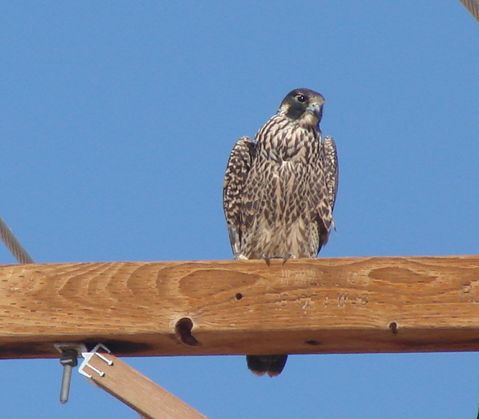
literally means “to introduce something again.” The Peregrine Falcon [for example, or the Wild Turkey] was never introduced to North America at any time in history, nor was the species foreign or alien. Therefore, by definition, the species cannot be reintroduced to that region….
Huh?
Stacia relies for her etymological argument — always dangerous — on the mistaken idea that the prefix “re-” means only “again” or “again and again,” citing an actual dictionary — always dangerous — in support of her case.
Every elementary school teacher and every elementary school pupil knows better. The prefix is polysemic, as reading a little farther on in the dictionary would tell us. “Respond” doesn’t mean “to answer again and again”; it means to answer back. “Rescind” doesn’t mean to “take again and again”; it means to take back. “Reverse” doesn’t mean to “turn again and again”; it means to turn back.
And “re-introduce” doesn’t mean “to introduce again”; it means to introduce back, which is precisely what we have done with condors and falcons and turkeys and otters and elk and on and on. We have “led” them “back” “in” to their original range, if we want to be pedantic and etymological (and right) about it.
Stacia’s recommended alternative, “repatriation,” is silly enough that there’s no danger of its ever catching on. But I still find the arch pedantry of her argument (“It’s hard to expect the general public to use proper terminology on such topics when the experts fail to do so”) troubling, and there is a small risk, I suppose, that less confident souls could be led to worry that they’re not using the term “re-introduction” properly — even though all of us members of “the general public” really are.
I’ve taken a firm resolve to use the word “re-introduction,” in its current and correct meaning, at least once a day for the next week. Says the OED:
To return (a species of animal or plant) to a locality where it was formerly native, with the intention of re-establishing it in the wild.
My dictionary’s better than hers.
And what about that hyphen? Well, I once sat next to someone on a plane who was reading a book titled “Reengineering,” and it took me most of the flight to figure out that it wasn’t Dutch.
